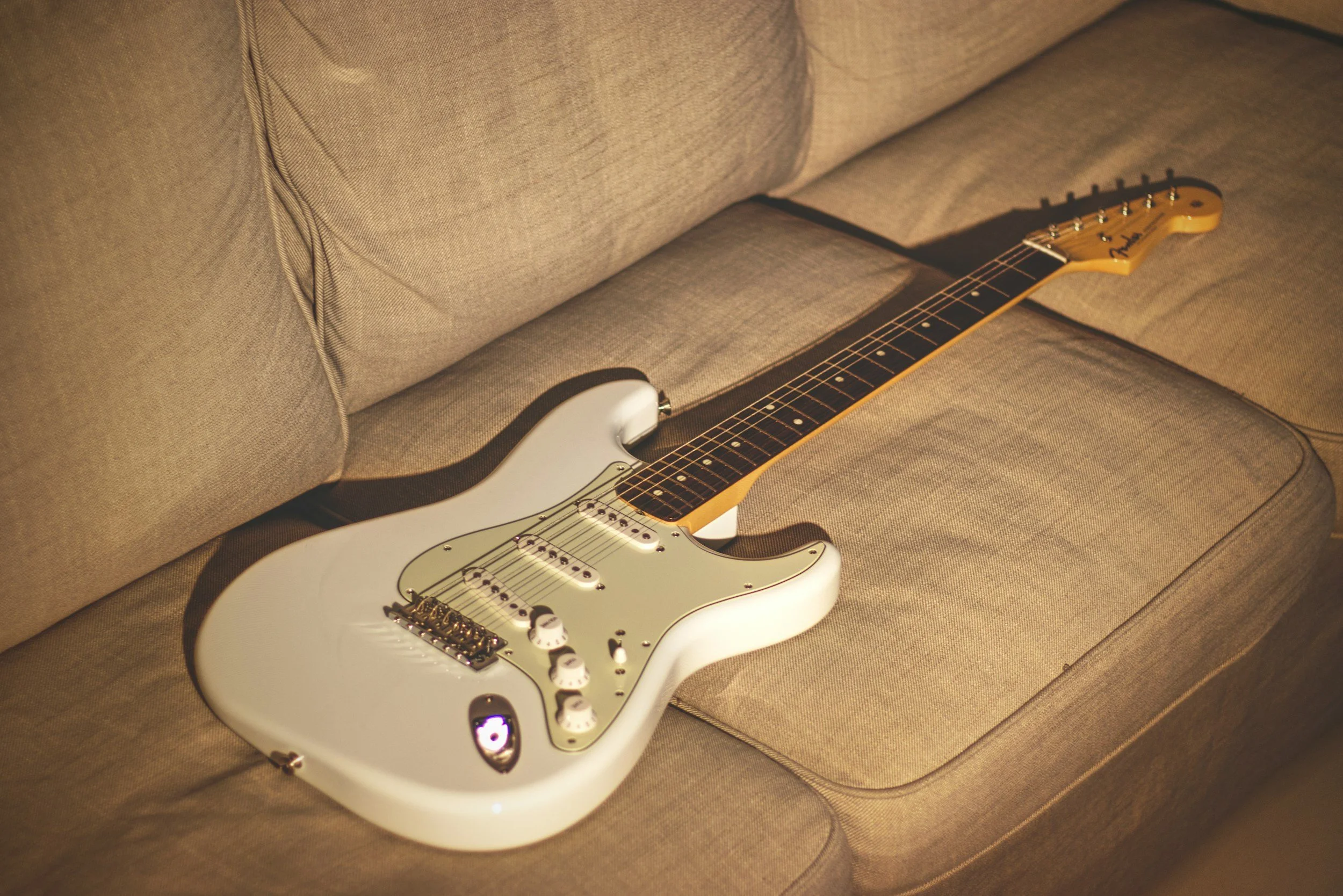
Steve specialises in fun and practical tuition in Electric or Acoustic Guitar for all ages and abilities across and can cater to a wide range in music tastes. Lessons are currently held at his home studio in the picturesque market town of St Ives, Cambridgeshire.
All abilities and ages (8+) welcome
Quality guitar tuition in a calm, relaxed atmosphere
Many different styles taught – Rock, Pop, Blues, Acoustic Fingerstyle, Country, Funk, Folk, Bluegrass, Jazz and more!
Steve has carefully crafted and created his own syllabuses from 16 years of teaching and carefully figuring out the best roadmaps to success on the instrument; however, no two pupils are the same - lessons are therefore tailored and adapted to fit each individual student’s needs. Some students prefer a structured approach whereas some prefer following their own unique tastes. Some prefer a more theory-based approach, some prefer to use songs mainly as their vehicle for learning - Steve is happy to tailor lessons to your needs, personal goals and work at your own pace.
Some students wish to study the grade system - Steve currently holds a 100% Merit/Distinction student pass rate for graded exams.
From the academic year starting September 1st 2026, Steve will be extending his hours and opening up some new time slots for his studio.
OPENING TIMES
Monday: 4-8PM
Tuesday: 12-2PM, 3:30-7:30PM
Wednesday: 12-2PM, 3:30-7:30PM
Thursday: 12-2PM, 3:30-7:30PM
Please note: Lessons are held on or half past the hour. Most peak times are now gone and there is currently a waiting list for certain slots, but it’s worth sending a message to see what’s still available.
TERM TIMES
Autumn Term 2026: 1st September – 18th December (Half term break: 26th - 30th October)
Spring Term 2027: 4th January – 25th March (Half term break: 15th - 19th February + Easter Break: 26 March - 9th April).
Summer Term 2027: 12th April – 27th July (Half term break: 31st May - 4th June)
Summer Lessons: 2nd - 13th August
I will be holding string changing workshops (free to attend) to enrolled students each half term. There will be free tea, coffee and freshly baked goods for attendees. Spaces will be very limited, so will be on a first come first serve basis.

Lesson Pricing
Enrolment at St. Ives Guitar Academy is a flat monthly fee due on the 1st of each month. Lessons are invoiced monthly with 42 lessons per year averaged across the 12 months.
New students will have a one-off trial lesson to see if we’re a good fit, priced pro rata.
New rates for academic year 2026-2027:
30 minute lessons:£88 per month
1hr lessons:£158 per month
Prices are in line with the current Musicians Union recommended rates.
Starting part-way through the academic year? No problem! Your monthly payment will be the same as other students, after a separate invoice for the difference of the first month to bring payments up to date for the current academic year.
Already play? Book your free 30 minute consultation - I’ll see where you’re at, find out your goals and work out a pathway to help you achieve them.
-
Payment is a flat fee due on the 1st of each month. The fee is based on 42 lessons per academic year, at a rate of ~ £25 per 30 min lessons, or ~£45 per 1hr lesson. I am switching to monthly payments to make budgeting easier for families and reduce admin time. You'll pay the same total amount across the year, but in smaller, more manageable monthly payments.
The fee you are paying is to hold a slot in my calendar. Sadly I am not able to reschedule if you can’t make a lesson or you’re sick - however, I know that life sometimes gets in the way, so I offer a couple of popular solutions for these scenarios (see below).
Payment is collected via Direct Debit. If starting part way through the academic year, your monthly payment will be the same as other students after a separate invoice for the difference of the first month to bring payments up to date for the current academic year.
-
Item description
-
Absolutely! I think it’s important to make sure my teaching style works for you, and for you to gauge over the course of a week or two whether you think you’ll be able to commit to regular practice.
For absolute beginners, the one-off trial lesson will be an hour long (there’s quite a lot of info and playing in the first lesson!) priced at £45.
If you already play, we can book a free 30 minute consultation so I can find out where you’re at, your musical background and start to form a plan to achieve your goals.
-
No problem! Sometimes life gets in the way and you’re not able to make it to a lesson, or you get sick.
Please don’t come to the studio when you’re sick. I cannot refund you or reschedule ‘make-up’ lessons as you’re paying to block off a slot in my calendar, but I offer a couple of popular alternatives instead.
VIRTUAL LESSONS
Held over Zoom.
ASYNCHRONOUS LESSONS
Record yourself playing what you’re working on and I'll use your lesson time to review footage/questions and then send a short video back with advice and new assignments etc. Please note: This must be submitted before your lesson slot.
-
The monthly fee covers your reserved lesson slot throughout the year and is calculated based on the total number of lessons offered annually. As outlined in the studio policy, payments continue during holiday periods, and no refunds are provided for family holidays.
-
If you need to discontinue lessons, please provide the required notice as outlined in the studio policy. Your final payment will be adjusted accordingly based on the lessons available up to the end of the notice period.
If you’re looking to pause lessons, sadly I cannot hold your space, but I can put you on my waiting list when you’re ready to return.
Frequently Asked Questions
-
For complete beginners we start with a one-off hour session. There’s quite a lot of foundational information here but I aim to get you playing music you’ll recognise and enjoy straight away. There’s no obligation to sign up on the lesson plan - this hour is for seeing if we’re a good fit going forward. After that, 30 minute lessons once a week are all you need - Each week I’ll review how you’ve gotten on and assign you new material when needed. Beginners just need to be able to commit to a few 10-15 minute practice sessions in between lessons (see below for more info on practice).
If you already play, please get in touch to organise a free 30 minute consultation. In this casual session we’ll play a bit so I can see where you’re at, chat about your musical background, music taste, and work out any goals you may have. I’ll then put together a roadmap to help you achieve these goals. It’s very common for self-taught players to have gaps in their knowledge that might have been skipped - please be prepared that there will probably be some basics in there that need work and attention before moving on to more advanced material.
Once signed up for lessons and the first Direct Debit comes through, I’ll give you access to your own Student Portal. Here you’ll find notes from each lesson + any supplemental materials, videos, downloads etc etc. We’ve all got busy lives, so it can be easy to forget what we’ve covered and what you’re supposed to be working on, so it helps to have online for reference. The portal also has a practice diary - a super useful journal to fill out to keep track of your practice sessions. I have kept practice journals for many years and can attest to how helpful they are for progress.
Lessons are held at my home studio in St Ives & I have free parking directly outside the property. All you need to bring is your guitar, a clip-on tuner (although if you haven’t got a tuner yet, you’re welcome to use one of mine for the lesson), a guitar pick (I recommend purchasing a variety pack of different shapes and sizes) and a project folder - I will be providing lesson materials each week to take home, and the folder is essential for keeping organised.
-
This is up to you and the kind of music you’d like to play. It’s a common misconception that you have to start on acoustic - I believe you should choose the one that makes you want to play. Personally, I started on electric as I was an 11 year old who just wanted to play loud rock music and make a lot of noise! I started to move into more acoustic based playing a few years later.
Acoustics and electrics both have advantages/disadvantages at the start:
Ease of playing: Electric is easier to play at first due to the thinner strings, neck and lower action (distance between strings and neck), so much easier to progress. Acoustic is tougher to start with but builds your strength and calluses quicker. Generally I’ve found the best results at the start tend to come from those starting on electric.
Budget: It’s easier to find a good lower budget beginner acoustic (around £100), whereas there’s more of an outlay for a good starter electric (as you need the guitar, cable and amp). However, you can save a lot of money going secondhand if you know what you’re looking for. I’m always happy to help students find equipment for their budget :)
-
It’s a bit of a minefield at the lower budgets (£100-250). You can get a lot more bang for your buck on the used market, but you need to know what you’re looking for (feel free to reach out to me for guidance).
For acoustic guitar, brands like Yamaha, Fender, Sigma, Tanglewood and Aria are good starting points.
For electric guitar, you can’t go wrong with a Yamaha Pacifica - a timeless, solid choice for beginners! You also generally can’t go wrong with brands such as Fender, Squier or Epiphone. For amplifiers, a small practice amp with some built-in effects (and ideally a headphone socket) would be a great choice, e.g. a Blackstar ID Core, Positive Grid Spark, Yamaha THR or Boss Katana. Please note, practice amps are usually a lot cheaper secondhand.
I highly recommend checking out the fantastic local store Music Street in Huntingdon for help selecting your first guitar. It’s important when picking out a guitar to see and try a selection, as each one is different! They will walk you through your options, check it out the box and set it up to how you’d like it - an option you wouldn’t get shopping online - we must support our local music shops as we’ve now sadly lost most of them.
If looking online or at the used market, please consult with me before purchasing something, I’m happy to help! It’s fairly common that when buying used, the guitar might need a setup to get it playing as well as it can, so you might need to factor this cost into any purchases.
-
Every student is different, but I generally recommend 30 minute lessons per week for most, especially those in the beginner phase.
For the more dedicated and advanced players (e.g. working on the higher grades and beyond), 1 hour lessons could be a better fit to work through specialised material.
Please note, the lesson is guidance and coaching for what you need to work on at home. Think of it like a north star guiding and helping you to get where you want to go. It is not in place of practice - the daily playing and the quality of your practice is vital for good progress.
-
When learning an instrument, you will generally get out of it what you put into it. Consistency and frequency is crucial for good progress. E.g. 4-5 practice sessions a week (not including the lesson). However, these don’t need to be long sessions! The quality of what you do in these practice sessions is much more important for results.
The amount of practice time needed depends upon the student's level and goals. Parents, please keep in mind that children are rarely self-motivated and more often-than-not lack the maturity, self-discipline, and long-term perspective to put in that all-important practice session, especially at the start when the instrument is particularly challenging. Please set up a practice time for your child that is part of the daily routine.
You’d be surprised at what you can achieve with regular short bursts of playing at the start. ‘Practice’ is a bit of a scary word - I much prefer ‘playing’! Generally at the start, I just want students to get into the habit of picking up the guitar and playing. This can be achieved with something so simple like setting up your environment for success. Keep the guitar out of your case, on a stand and always within sight of where you hang out the most and just try and get in the habit of picking it up regularly. Once you’re in the habit, you can start to refine your practice sessions and make them gradually more and more focused.
Once we’re in the habit of picking up the guitar and playing regularly, we can then optimise our practice sessions for success by learning some basics about how the brain learns. This is a big topic in our lessons: there has been a lot of development & research in the field of neuroscience and how to effectively & efficiently learn new skills, and I have a few simple tips and tricks on how I use this to my advantage every day in my own practising.
-
Sorry, I can only accommodate for weekly lessons. In my experience, fortnightly lessons are generally not particularly useful and are likely to hinder progress, especially in the early stages - The regular feedback loop between student and teacher is essential to make sure no bad habits creep in, and it’s also important to keep momentum and energy going.
-
This is totally up to you and your own personal goals. A lot of students love that exams provide a clear structure and offer official certificates. One other great benefit is that grades 6, 7 and 8 provide UCAS points for getting into University.
However, they can also add stress and turn a fun hobby into a chore. I recommend checking out Rockschool exam boards - the choice of repertoire to learn per grade is fantastic (with songs from bands such as AC/DC, Metallica, Oasis, Foo Fighters etc to modern artists such as Ed Sheeran and Olivia Rodrigo) + they offer the much less stressful option of submitting pre-recorded video exams (a big hit since introduced).
Personally, I went through them to help me get into Music college. They are much more pleasant these days!
I do not pressure students into taking exams but I’ll gladly help if those are your goals. Currently I hold a 100% Merit + Distinction pass rate for students since I first started teaching 15 years ago.
-
Payment is a monthly flat fee based on 42 lessons in the academic year, taken via Direct Debit. Please see the Pricing guide.
-
I follow the general school term times + 3 weeks of the Summer holidays.
-
No problem! Sometimes life gets in the way and you’re not able to make it to a lesson, or you get sick.
Please don’t come to the studio when you’re sick. I cannot refund you or reschedule ‘make-up’ lessons as you’re paying to block off a slot in my calendar, but I offer a couple of popular alternatives instead.
VIRTUAL LESSONS
Held over Zoom.
ASYNCHRONOUS LESSONS
Record yourself playing what you’re working on and I'll use your lesson time to review footage/questions and then send a short video back with advice and new assignments etc. This is a useful option as it allows you to re-watch your personalised feedback over and over again. Please note: This must be submitted before your lesson slot.
-
Definitely not - In my years of teaching I have taught all ages, from 6 - 85!
Learning guitar is a challenging but very rewarding instrument. It is also fantastic for helping with cognitive skills and co-ordination. It’s just a fact of life that younger people (below 25 years old) generally are able to pick up new skills quicker when they put their mind to it. After 25 it’s of course still possible - for most adult learners progress is just a bit slower in terms of developing finger dexterity but you just need a bit more focus in your practice sessions. Adults also have to deal with a lot more real distractions such as career, feeding your family etc - so we must work smarter (not necessarily harder) - consistency is still king - small, focused and regular practice sessions will still provide you with great results.


Get in Touch
To book lessons, please fill out the form.
I’ll be in touch within 24-48 hours.